
The Right to Write
And the creeping evil that threatens it

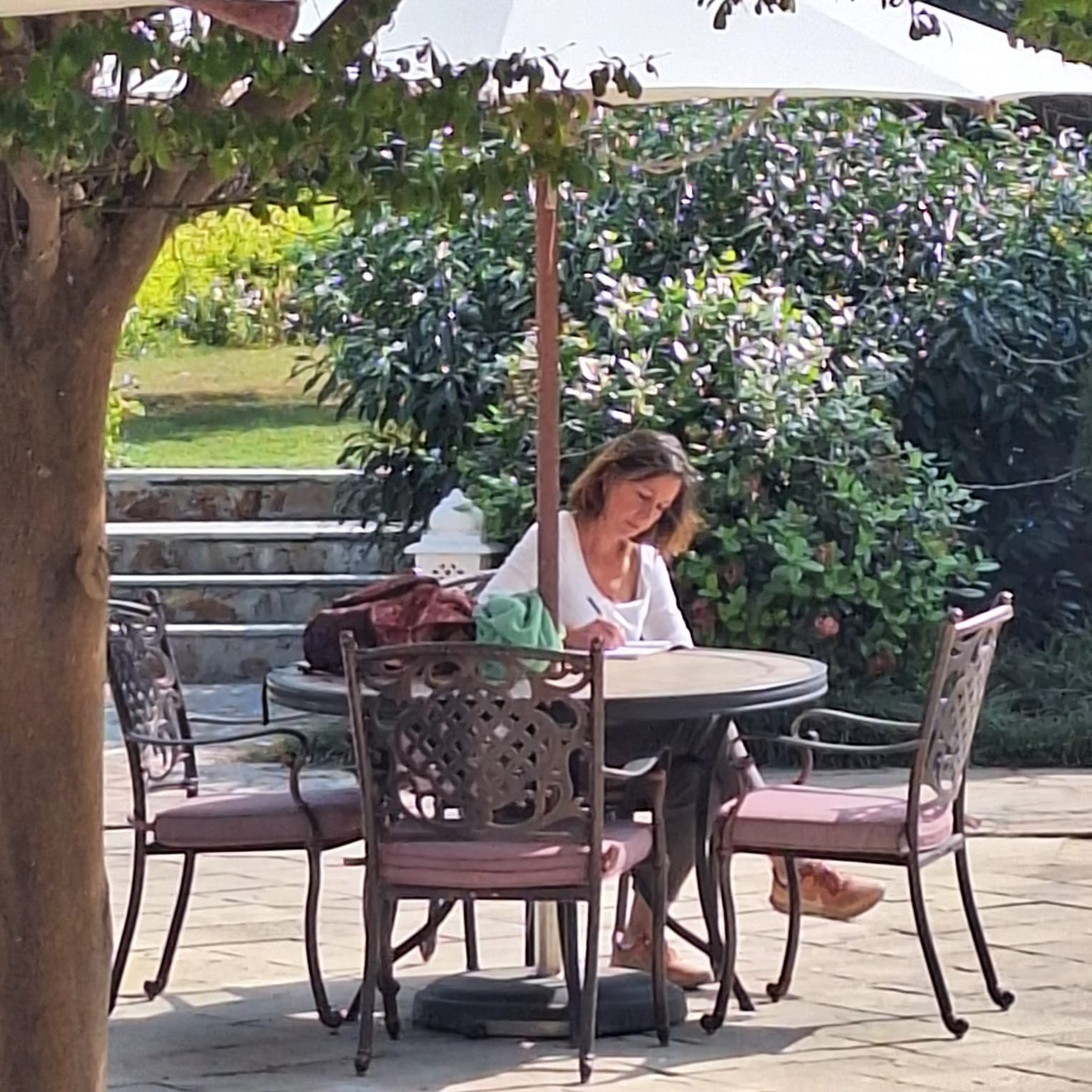
There is nothing disposable about a BIC or Biro.
Parker, Paperweight, Cross. Hold any one of these in the palm of your hand and feel the weight – not just of the parts, but of the possibilities. The worlds and words. And more terrifyingly, the lack thereof.
They can be like a sun, words.

They can do for the heart

What light can

for a field.

(John of the Cross, Love Poems to God)
I have used these words many times in writing circles, vaguely aware of the author, but more impressed by the sentiment. Who could argue with the power of words to pierce our defensive breastplates and let flow the sweet and sticky mess of life?
But as a student of the CAC’s Living School, I recently learned of the circumstances in which these words were written; the extraordinary suffering that somehow blossomed into love, rather than bitterness; and my appreciation of the beauty and humility of the writer has almost eclipsed his words.
So who was, Juan de la Cruz, and what does his life, and the way he lived it, teach us today?
He was born, in 16th century Spain, in poverty, to (probably) a Jewish father forced to convert to Catholicism, and a north African mother. His father died while he was an infant and so the tiny family became itinerants, moving from place to place, trying to make a living. As an adolescent, Juan found work in a hospital, nursing patients dying from syphilis. He showed extraordinary compassion, and came to the attention of a Carmelite monk, and was encouraged to attend university, with a view to becoming a Carmelite himself.
He lived, however, within the gnashing jaws of the ‘pure-blood’ obsessed Spanish Inquisition, and despite support from the King, who was in favour of the reforms Juan and others (like Teresa of Avila) were proposing, he was kidnapped by his holy brethren, incarcerated and tortured. Imprisoned in a tiny cell, a toilet actually, he was brought out to be flogged in the centre of the dining area, while the monks ate dinner. He was starved, frozen in winter and in the stifling heat of the summer, the rags he wore began to rot his flesh. In the depths of despair, he experienced a Dark Night of the Soul, but in the blinding light of his dawn, he began to compose, in his mind (he had nothing to write on), passionate love poems to God.
Eventually he escaped to a nearby convent and was cared for by the sisters, his relief finally pouring forth in the form of a poem of the profound joy at meeting God during his dark night. The shrewd nuns presumably noticed that his poem was erotic, with the soul, the lover, feminine in Spanish, and the Beloved, masculine in Spanish, in reference, but to, but not naming God. If you’ve read Rumi or the Song of Songs, or Christina Rossetti, you’ll be comfortable with soul and God as lovers, but you have to pick your burnt-at-the-stake moment, so he was urged to write a commentary to explain himself. This became the classic 200 page Dark Night of the Soul. Read it to understand the bounty to be found in genuine humility and loss of ego, as opposed to a self-obsessed, self-improvement manual, or worse, a manifesto of right-wing Christian fundamentalism.
450 years later, the glorious empire of the Judea-Christian West has progressed: democracy, equality, free trade, with rubber tariffs. We have stopped burning people, though perhaps only temporarily. We do, however, take many things for granted - our right to free speech, our access to ink. To have either withheld, here, in the civilised world, would be to deconstruct our entire sense of order, to tip us into panic and despair. We have evolved, maturely, past the need to build high walls and retreat into echo chambers of our own brilliance. We can write without fear of being cancelled…
As someone who innocently crayoned through childhood - from scribbles and CVC words in Ladybird books; from glitter pens and bubble writing in teenage jotters; to endless notes of endless meetings in endless Moleskins, I have authored myself into being, I have written my freedom, I have never questioned, until now, my right to hold a pen, or form a view.
But think of the efforts to get us these technologies. The wilful monks and nuns who stopped preaching in high Latin; the printing press that released the bible, and thus literacy, into the hands of ordinary people; the gradual democratisation of, not just the Word, but all words.
Pens are politics. Think how liberated we who hold pens are, thanks to the efforts of those who endured pain and worse in the name of what is right; how extraordinary to imagine it could be any other way. When I hold a pen in my hand, I am holding history. Struggle, liberty and bounty. I am holding a limb, a pulse, a lung.
Before his incarceration, John had a vision that he was looking down on Christ on the Cross, and later produced this inky sketch circa 1574-77.
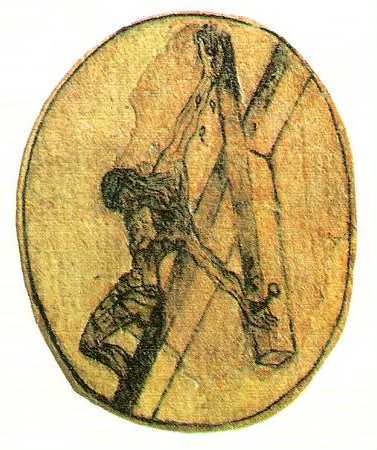
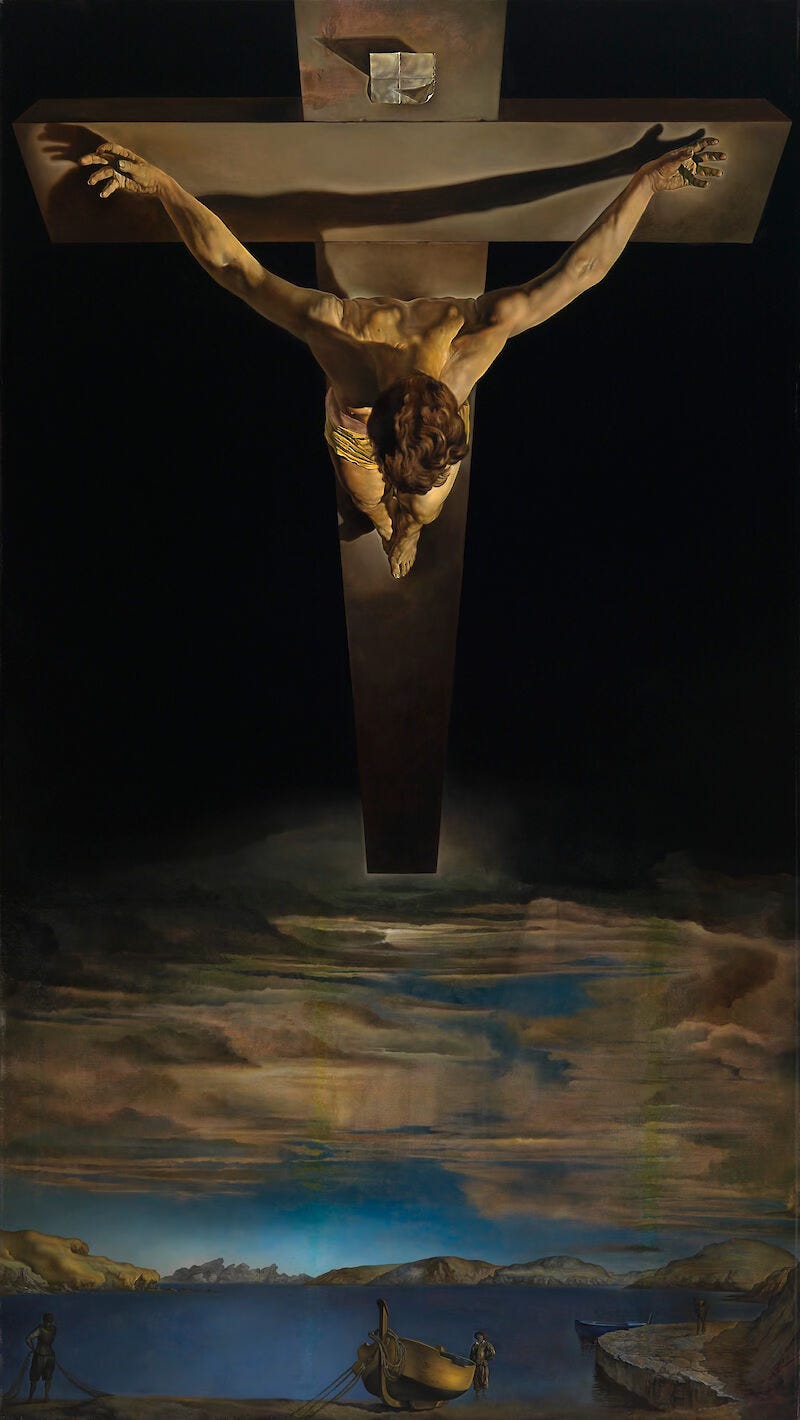
Centuries later, Salvador Dali after seeing this striking image, experienced his own dream and vision, and brought into being the Christ of Saint John on the Cross, one of the most breathtaking pieces of (religious) art, and as all Glaswegians know, our city’s pride and joy. I will never forget the first time I saw it in the Kelvingrove Art Gallery and Museum, about 40 years ago. At the end of a corridor in a gallery, I walked towards it, falling into the vision of the view of our beautiful earth, from the exalted and unimaginable horror of the cross. I felt the exquisite pain in my bones. I still do.
Think of the freedom of expression of every poet, every artist, every toddler scribbling. Think of the rights we take for granted, because how utterly unimaginable that anyone would ever threaten them. Think about what is happening over there and how it seems to be spreading, icily, over here.
Think of those, like Jesus, like John of the Cross, who experience a Dark Night of the Soul, become stripped of all ego, who in breaking open, show true heroism. Think of the mature, civilised West that you assumed would continue on its trajectory, envy of the world. Think again.
Think deeply about what we cannot afford to lose. Our open hearts. Our right to welcome the stranger. Our humanity.
What Every Woman Should Carry

My mother gave me the prayer to Saint Theresa.
I added a used tube ticket, kleenex,
several Polo mints (furry), a tampon, pesetas,
a florin.  Not wishing to be presumptuous
not trusting you either, a pack of 3.
I have a pen.  There is space for my guardian
angel, she has to fold her wings.  Passport.
A key, Anguish, at what I said/didn’t say
when once you needed/didn’t need me.  Anadin.
A credit card.  His face the last time,
my impatience, my useless youth.
That empty sack, my heart. A box of matches.

by Maura Dooley
What all of us should carry is awareness. Take nothing for granted except your capacity to love and be loved. Not fluffy, bubble writing Hallmark love, but the compassionate, caring, messy kind. The, my neighbour has just been kidnapped by the state, kind. If we can emerge from the hatred facing us with even half the love that John of the Cross implores, his struggle will have been worth it.
This post was inspired by the Centre for Action and Contemplation, and in particular, Mirabai Starr’s and Jim Finley’s analysis of John of the Cross.